Skip to content
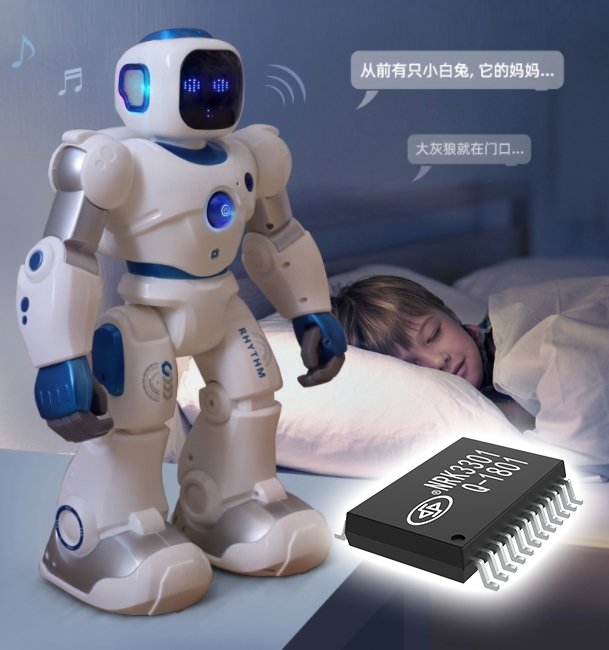
Table of Contents
Why Toy Robots Are Dominating the Smart Toy Market
In today’s digital age, toy robots have evolved far beyond simple entertainment. They’ve become intelligent companions that spark curiosity, boost language development, and encourage interactive learning for children. One of the key innovations behind this transformation is voice recognition technology, which allows children to control and communicate with their toy robots using natural speech.
To meet these growing expectations, manufacturers are turning to advanced offline voice recognition chips that deliver fast response, accurate recognition, and reliable performance—without relying on cloud connectivity.
Introducing the NRK3301 Offline Voice Recognition Chip
The NRK3301 is a powerful offline voice recognition chip designed specifically for interactive smart toys. Developed by Jiuxin Electronics, this chip integrates advanced TDNN (Time-Delay Neural Network) algorithms to deliver high-accuracy recognition with minimal false triggers. It supports reliable far-field recognition up to 5 meters, making it ideal for use in children’s environments.
Unlike online solutions, the NRK3301 processes voice commands locally, offering instant response and enhanced privacy protection, with no internet connection required.
What Can Toy Robots Do with NRK3301?
The NRK3301 enables a wide range of interactive features in educational toy robots, including voice-controlled media playback and intelligent conversation. Typical voice commands (customizable) include:
- Start-up Greeting: “Welcome to your smart toy learning robot.”
- Play English Music: “Switching to English music mode.”
- Play Chinese Classics: “Now playing Chinese classic music.”
- Play Nursery Rhymes: “Entering nursery rhyme mode.”
- Tell a Story: “Sure, what story would you like to hear?”
- Play ‘Wolf and Grandma’: “Okay, playing now.”
- Pause/Stop Music: “Music paused/stopped.”
These examples illustrate how offline voice interaction makes the robot toy both fun and functional.
NRK3301 Technical Highlights
The NRK3301 isn’t just smart—it’s built to perform. Key features include:
- High-performance 32-bit RISC core, running at 240MHz with hardware floating-point support
- Built-in 1MB SPI Flash
- Offline voice recognition using the latest TDNN neural network algorithm
- 5-meter far-field recognition with low error rate and high precision
- Advanced noise reduction: blocks steady-state noise and suppresses dynamic noise for accurate detection
- Multiformat audio decoding: MP3, WAV, WMA, APE, FLAC, AAC, MP4, M4A, AIF, AIFC
- Sample rate support: from 8KHz to 48KHz
- Stereo analog MUX with three-channel support
- Voltage ranges: VBAT 2.2V–5.5V, DDIO 2.2V–3.6V
This robust feature set makes it a favorite among smart toy manufacturers looking for a low-cost, high-efficiency voice solution.
Why NRK3301 Is the Preferred Choice for Smart Toy Makers
By integrating the NRK3301 offline voice recognition chip, toy manufacturers can:
- Eliminate dependence on cloud connectivity
- Deliver instant, smooth voice response
- Improve user privacy with local data processing
- Reduce integration complexity and cost
- Create customizable interactive experiences
These advantages make NRK3301 an ideal solution for next-generation toy robots, smart early education devices, and interactive storytelling machines.
Conclusion
As voice technology becomes the new interface for toys and learning tools, the NRK3301 offline voice recognition chip stands out with its advanced AI algorithms, stable performance, and offline flexibility. For toy manufacturers seeking reliable, fast, and child-safe interaction, NRK3301 is the chip that brings voice to life—without the internet.